How Lewis approves a preceptor and clinical site for each practicum
A preceptor and site count toward a Lewis practicum only after Clinical Coordinators and/or track lead faculty approve them for a specific course. Lewis's test is fit: the match must "best meet the needs of the student in the designated course." Below is what fit looks like for each NP practicum, the catalog conflicts to settle first, and the separate clearance your agency gives afterward.
Get your placement plan
Tell us your Lewis program and where you live. A placement advisor replies with preceptor and site options in your community that fit your Lewis course.
Who signs off, and on what
Approval at Lewis is tied to a course, not to a person in general. The MSN FAQ gives the decision to Clinical Coordinators and/or track lead faculty, and the yardstick is what you need in the course the hours are for. A preceptor who is ideal for adult primary care may be the wrong choice for a pediatric practicum, and the same preceptor can suit one of your courses and not another.
Lewis's directories name those faculty roles. The Spring/Summer 2026 course schedule directory lists an FNP Track Coordinator, an AGACNP/AGPCNP Tracks Coordinator and a PMHNP Track Coordinator. The nursing faculty page words them differently: a Primary Care Track Nurse Practitioner Coordinator, an Adult Gerontology Acute Care Nurse Practitioner Track Coordinator, and one coordinator covering both School Nurse and PMHNP. The Clinical Placement Office facilitates; the approval itself belongs to faculty.
Two gates: Lewis's approval and the agency's clearance
Faculty approval settles whether the match fits your course. The agency then settles a separate question: whether it will let you in. In Lewis's contract legend, after the school-agency contract is in force, the request waits for the agency to confirm you are cleared, and any extra documents the agency wants go to it and to the Clinical Placement Office. The status-by-status version is on the contract portal guide.
Health systems keep their own gates. Northwestern Medicine's own student page limits placements to schools with a current affiliation agreement and puts its own staff first. Riverside Healthcare in Kankakee says on its NP student page that its NP students usually train alongside a CNP or CCNS. A preceptor's personal yes is essential, but it is only the first of several approvals.
What a good fit looks like, practicum by practicum
Lewis publishes each practicum's title, its tracks and, for most, its clock hours. The last column is our reading of what each title calls for in a preceptor and setting, not a Lewis criterion; your syllabus and your track coordinator decide.
| Course | Lewis title and tracks | Clock hours Lewis prints | A fitting preceptor and setting |
|---|---|---|---|
NURS 61100 | NP Practicum: Adults in Community/Primary Care (FNP, AGPCNP) | 180 | Adult primary care: a family or internal medicine practice, or a community health center |
NURS 61800 | NP Practicum: Adult/Gerontology and Adolescents (FNP, AGPCNP, AGACNP) | 180 | A practice that sees adolescents through older adults; AGACNP students confirm the setting with their track |
NURS 64100 | FNP Practicum: Primary Care of Women (FNP) | None printed | Women's health, OB-GYN, or a family practice with a large share of women patients |
NURS 64300 | FNP Practicum: Primary Care of Infants & Children (FNP) | None printed | Pediatric or family practice with regular well-child and sick visits |
NURS 61500 | AGPCNP Practicum: Special Populations (AGPCNP) | 180 | Adult-gerontology primary care reaching the special populations your course names |
NURS 62500 | NP Practicum: Acute Care for Adult/Gerontology (AGACNP) | Text says 360 total | Hospital-based acute care with an acute care provider |
NURS 62700 | NP Practicum: Acute Care for Adult/Gerontology 2 (AGACNP) | None printed | Acute care with subspecialty patients and acute care devices and technology |
NURS 63300 | PMHNP Practicum 1: Assessment and Diagnosis Across the Lifespan | 180 | A psychiatric practice doing diagnostic evaluations across age groups |
NURS 63500 | PMHNP Practicum 2: Introduction to Psychotherapy | 180 | A psychiatric provider who delivers psychotherapy |
NURS 63700 | PMHNP Practicum 3: Implementation of Pharmacotherapy | 180 | A prescribing psychiatric provider with a medication management caseload |
NURS 79600 | DNP Residencies (DNP) | 168 per 3 credits | A preceptor in your practice setting willing to work to an individualized learning contract with you and your faculty member |
Lewis runs all NP specialization courses in a 16-week format, so the preceptor has to be available across the whole term; how those courses pair with their management courses is on 16-week NP courses.
Catalog conflicts to settle before you ask
Three gaps in Lewis's catalog change how you describe a practicum to a preceptor. Settle them with your track before anyone commits to a schedule.
NURS 62500's description says 360 total clock hours, while the program's 540-hour AGACNP total spans three practicums andNURS 62700states no hours at all. As printed, the figures do not reconcile; see the AGACNP acute care practicums.- Neither
NURS 64100norNURS 64300lists clock hours. In 2024-25 the retiredNURS 61700covered women and children in one 270-hour course, and Lewis has not said how the 630-hour FNP minimum now splits between the two; see the FNP women's and pediatric practicums. NURS 61100is described as the first of three clinical courses, yet FNP students take four practicums.
A preceptor who agrees to one number of hours and is later asked for another is a preceptor you may lose. Get your course's figure from the track coordinator in writing first.
What Lewis screens in a preceptor
Lewis publishes no preceptor credential list by track: nothing on NP versus physician preceptors, years of experience or board certification. What its contract legend does reveal is screening. IDFPR discipline is one ground to deny a contract; conduct Lewis considers unsafe or questionable, by the preceptor or the agency, is another. That implies Lewis looks at the preceptor's license record and conduct, not only their title.
Illinois law adds little on this point. The preceptor provisions in 68 Ill. Adm. Code 1300.340 govern RN programs, and Illinois sets no qualifications for APRN preceptors. It does reward them: an APRN can count 10 continuing education hours for each student precepted in a semester, up to 30 per renewal. What is known about qualifications is on preceptor requirements, and the denial grounds are on why contracts get denied.
Presenting a match that clears approval
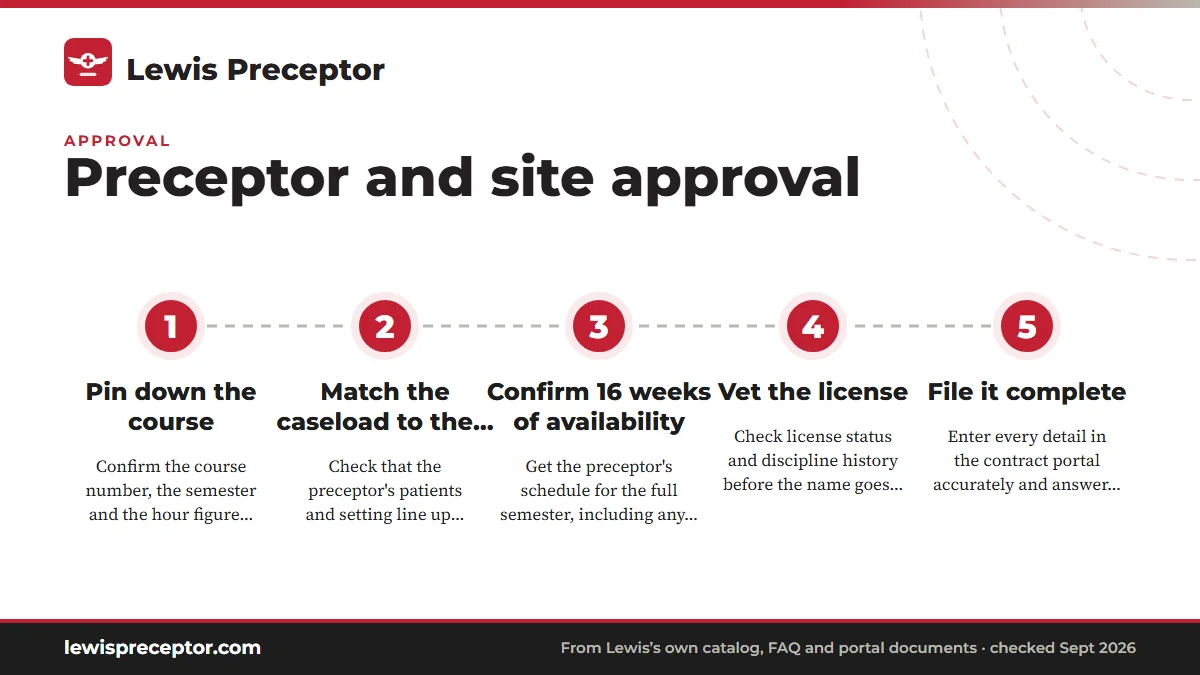
- Pin down the courseConfirm the course number, the semester and the hour figure your track uses for that practicum.
- Match the caseload to the titleCheck that the preceptor's patients and setting line up with what the course covers, using the table above as a starting point.
- Confirm 16 weeks of availabilityGet the preceptor's schedule for the full semester, including any planned time away.
- Vet the licenseCheck license status and discipline history before the name goes anywhere official.
- File it completeEnter every detail in the contract portal accurately and answer reviewers' questions quickly.
The placement desk handles the first four steps for you and hands over the fifth ready to enter, with a preceptor chosen for the exact Lewis course. See how it works.
Questions Lewis students ask
Can a physician precept a Lewis nurse practitioner student?
Lewis publishes no rule on whether preceptors must be nurse practitioners or may be physicians or physician assistants. Faculty decide course by course, so ask your track coordinator before approaching anyone outside nursing. Whoever you choose, a clean license record matters, because IDFPR discipline alone can get a contract denied.
How long does approval of a preceptor and site take at Lewis?
Lewis does not publish a timeline for the faculty decision. Its contract legend sets two weeks as the minimum processing time for a request, and longer when a new affiliation agreement has to be drafted and signed by the agency. The agency's own clearance comes after that, on the agency's schedule.
Can the same preceptor cover two Lewis practicums?
Nothing Lewis publishes rules it out, but fit is judged for each designated course. A family practice preceptor might suit NURS 61100 and NURS 61800 yet fall short for NURS 64300 if the practice sees few children. Present each course to your track on its own and expect each to be weighed separately.
Do DNP residency preceptors go through the same approval?
The FAQ's approval passage sits under a heading for the MSN and CAS NP tracks. For the DNP, the catalog frames NURS 79600 residencies as a three-way arrangement of preceptor, student and faculty member, guided by an individualized learning contract, and the contract portal applies to every clinical practicum. Expect both a portal request and faculty sign-off.
What happens if Lewis does not approve my preceptor?
Lewis publishes no appeal step for a declined match. Ask your track coordinator why, because the answer tells you what the next preceptor needs: a closer caseload fit, a different setting or a cleaner license record. Then move quickly; students working with us get the next candidate already matched to the course.
Related pages
Last checked 2026-09-25
We check these pages against Lewis's own catalog, program pages and FAQ, its contract portal and Illinois law. Your course, your track coordinator and the Clinical Placement Office have the final word.
Lewis asks you to identify your preceptor. We do the searching.
Tell us your Lewis program, where you live and when your next practicum starts. We find preceptors near you who fit the course and prepare every detail the contract portal asks for, so your request goes in complete.
- Preceptors matched to the practicum: primary care for
NURS 61100andNURS 61800, acute care forNURS 62500, psychiatric care forNURS 63300 - Preceptor, license and site details ready for your preceptor contract request
- In your own community, anywhere Lewis enrolls you and your RN license is valid
Start your placement plan
Program, city and start date is all we need to begin.