Searching on your own or with help: a fair comparison
Both routes end at the same Lewis gate: a contract request, a review, faculty approval and the agency's clearance. What differs is who spends the weeks of calls and checking before that gate. Plenty of Lewis students find excellent preceptors themselves, and others hand the search to a service so the semester stays safe. Here is how the two compare, point by point.
Get your placement plan
Tell us your Lewis program and where you live. A placement advisor replies with preceptor and site options in your community that fit your Lewis course.
One Lewis process, whichever route you take
Lewis asks NP students to play an active role by identifying preceptors, and its Clinical Placement Office facilitates from that point on. Lewis's public pages neither endorse nor rule out outside placement services, and they describe no separate track for them. A preceptor you meet through a colleague and one a service locates are filed, reviewed and approved the same way.
That makes the decision a practical one. It turns on your available hours, your professional network, the course in front of you and how near the semester is, not on a route Lewis favors. Either way, the student who starts early and files a complete request is the one in the strongest position. What the FAQ expects of you is laid out on identifying preceptors.
Side by side
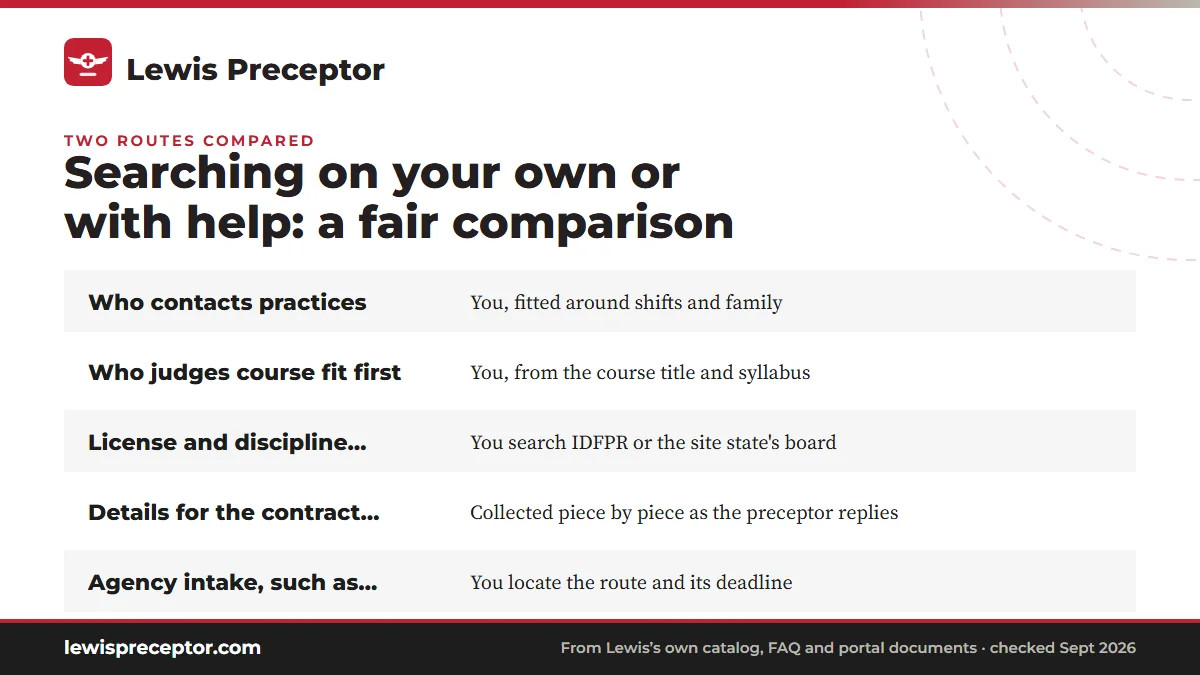
| Question | Your own search | With a placement service |
|---|---|---|
| Who contacts practices | You, fitted around shifts and family | The service's staff, during clinic hours |
| Who judges course fit first | You, from the course title and syllabus | The service, with open questions sent to your track coordinator |
| License and discipline lookup | You search IDFPR or the site state's board | Completed before you are introduced |
| Details for the contract request | Collected piece by piece as the preceptor replies | Delivered as one set, ready to enter |
| Agency intake, such as myClinicalExchange | You locate the route and its deadline | Found and scheduled for you |
| Who submits the request | You | You |
| Who approves | Clinical Coordinators and/or track lead faculty | Clinical Coordinators and/or track lead faculty |
| If the preceptor withdraws | You restart the search | The service runs the replacement search |
| What it costs you | Your time, often many hours | A service fee and a small amount of your time |
The last row is the honest trade. One route spends your hours; the other spends money to save them. What shapes the price of a placement is explained on cost.
When searching on your own works well
Many Lewis students run a successful search themselves. The route tends to suit you when several of these hold true:
- You already know a nurse practitioner or physician whose practice matches the course, perhaps from work or an earlier rotation.
- Your employer runs the kind of clinic the course calls for and takes students; clinicals where you work lists what to settle first.
- The practicum centers on a common setting near you, such as adult primary care for
NURS 61100. - The semester is six months or more away and you have weekday time for calls.
- You are comfortable looking up licenses, tracking down agency contacts and meeting an intake deadline.
If that sounds like you, begin early, keep a dated log of every contact, and use Lewis's own guidance to shape the request before you file.
When outside help earns its place
Some searches are simply harder, and none of it reflects on the student. Specialty courses narrow the field: NURS 64100 calls for women's primary care and NURS 64300 for pediatric primary care, while NURS 63300, NURS 63500 and NURS 63700 call for psychiatric preceptors whose patients span the lifespan. The AGACNP's NURS 62500 and NURS 62700 lead to hospitals, and according to its NP student page, Advocate does not locate preceptors for NP students in Illinois.
Time is the other squeeze. Long hospital shifts, a practicum a few weeks out, a home far from the Chicago area or a preceptor who just withdrew all shrink the margin. In those situations, a team that searches full time, vets every candidate and prepares the paperwork can decide whether you start on the first day of the semester or partway through it.
Mixing the two routes
The choice is not all or nothing. Some students find their first preceptor through work and bring in help for a specialty practicum. Others pass along a lead they found and let a service finish the vetting. A few search alone until a set date, then switch if nobody has confirmed. Any of these can work, provided each lead is tracked and no practice is contacted twice by different people.
If you plan to mix, choose that switch date now. Count back from the first day of the semester and leave room for Lewis's two-week minimum review, a possible new affiliation agreement and the agency's own onboarding. The planning timeline shows how early that date falls for each practicum.
What stays the same with any service
Several things do not move. You still submit the contract request from your Lewis account, keep CastleBranch current, send each agency document to both the agency and the Clinical Placement Office, and arrange your own travel. Faculty still decide whether a preceptor suits the course, and the agency still decides when you are cleared to begin.
A service that promises approval, a start date or a special relationship with Lewis is claiming something only Lewis and the agency control. The honest offer is narrower and more useful: a well-matched preceptor, complete details and a fast replacement when needed. Before you sign up with anyone, choosing a placement service lists the questions worth asking and the answers a Lewis student should expect.
If you choose help, how we work
Lewis students choose us because preceptor searching is all we do, and we do it around Lewis's own steps. We read your practicum course first, search near your home, secure the full 16 weeks, look up the license, and collect the agency's agreement contact and intake route, then hand you a request ready to submit.
After that we stay close through onboarding and the semester: we help you answer the agency's questions, start a replacement search the day a preceptor steps back, and open your next practicum's search before the current one ends. Tell us your track and semester and a placement advisor will reply with a plan.
Questions Lewis students ask
Is it cheaper to find a Lewis preceptor on my own?
In money, yes: an independent search costs only your time. In time, it can run long, since calls, follow-ups and paperwork often take weeks, and a late start can end in an Incomplete with a fixed deadline. Weigh your hours, the course and how close the semester is before you decide.
Will the Clinical Placement Office treat me differently if I use a service?
Nothing Lewis publishes sets a different path for students who use outside help. The office facilitates the same contract request and review, and faculty weigh the same course fit. Keep corresponding with the office yourself, from your Lewis email, exactly as any other student would.
Can I start on my own and switch to a service later?
Yes, and it is a common pattern. Pick a cut-off that still leaves time for Lewis's review, any new agreement and agency onboarding before the semester opens. Pass along every lead and note when you switch, so no practice hears from two people and the promising ones are followed up first.
What if the preceptor I found can only cover part of the semester?
Lewis approves a site, the named preceptor or preceptors, and a semester, and its legend allows more than one preceptor on a request. A second preceptor at the same site may cover the rest. Ask your track coordinator whether a split suits your course before you accept the arrangement.
Does a service find preceptors faster than I would?
Often, because a service searches full time and knows which settings each Lewis course calls for. Speed still depends on the course, your area and the agencies near you, and the dates after a yes rest on Lewis's review and the agency's onboarding. Whichever route you choose, starting early matters most.
Related pages
Last checked 2026-09-25
We check these pages against Lewis's own catalog, program pages and FAQ, its contract portal and Illinois law. Your course, your track coordinator and the Clinical Placement Office have the final word.
Lewis asks you to identify your preceptor. We do the searching.
Tell us your Lewis program, where you live and when your next practicum starts. We find preceptors near you who fit the course and prepare every detail the contract portal asks for, so your request goes in complete.
- Preceptors matched to the practicum: primary care for
NURS 61100andNURS 61800, acute care forNURS 62500, psychiatric care forNURS 63300 - Preceptor, license and site details ready for your preceptor contract request
- In your own community, anywhere Lewis enrolls you and your RN license is valid
Start your placement plan
Program, city and start date is all we need to begin.