The Lewis post-master's DNP
Lewis's Doctor of Nursing Practice for MSN-prepared nurses is 30 credits, taught online, with a minimum of 504 residency hours beyond your MSN practicum hours, at least two DNP Immersions at Oak Brook and a scholarly project you defend. Residency and project work happen in person at a practice setting, and we help you find a setting and preceptor that fit your project.
Plan your DNP residency setting
Tell us your project focus, your license state and when your residency starts.
The 30 credits
The 2026-27 catalog lists one post-master's DNP, program DNP-NRSD-5. Five courses build the leadership, policy and evidence base; four project and residency courses carry the practice time.
| Course | Title | Credits | Practice time |
|---|---|---|---|
NURS 72000 | Design and Measurement for Evidence-Based Practice | 3 | None |
NURS 73500 | Transformational Leadership for Healthcare | 3 | None |
NURS 74000 | Healthcare Policy | 3 | None |
NURS 77000 | Quality and Safety Science in Healthcare | 3 | None |
NURS 76000 | Financial and Strategic Management for Healthcare Decision Makers | 3 | None |
NURS 79000 | DNP Scholarly Project Planning | 3 | Not stated |
NURS 79200 | DNP Scholarly Project Implementation | 3 | 168 clock hours |
NURS 79300 | DNP Scholarly Project Evaluation and Dissemination | 3 | Not stated |
NURS 79600 | DNP Residencies (taken twice) | 6 | 168 clocked hours per 3 credits |
NURS 72000, NURS 73500, NURS 74000 and NURS 76000 must be finished before project planning in NURS 79000. NURS 77000 expects NURS 53600 Healthcare Informatics, which may be taken at the same time; graduate statistics, population health and informatics you lack are added as bridge courses.
The 504 residency hours in brief
Lewis's catalog sets a floor of 504 residency hours for every DNP student, counted on top of whatever the MSN practicum required. NURS 79600 counts 168 clocked hours for each 3 credits and appears twice in the plan, and NURS 79200 adds 168 clock hours of project implementation. Reading 336 plus 168 as the 504 is our arithmetic; Lewis does not print that breakdown.
Your master's practicum hours sit outside this count, so treat the residency as new practice time on top of your MSN. Each residency has a preceptor, and the three of you (student, preceptor, faculty member) work from an individualized learning contract. How that contract works, and when a student repeats NURS 79600 to meet the hours, is explained on the DNP residency hours page.
The scholarly project, from essay to defense
Your project begins before admission. Lewis's application asks for a 1,000-word essay naming your planned project focus, and you must already hold an unencumbered RN license for the state that will host your residency. Those two choices, what you want to change and where, decide the kind of practice setting you will need later.
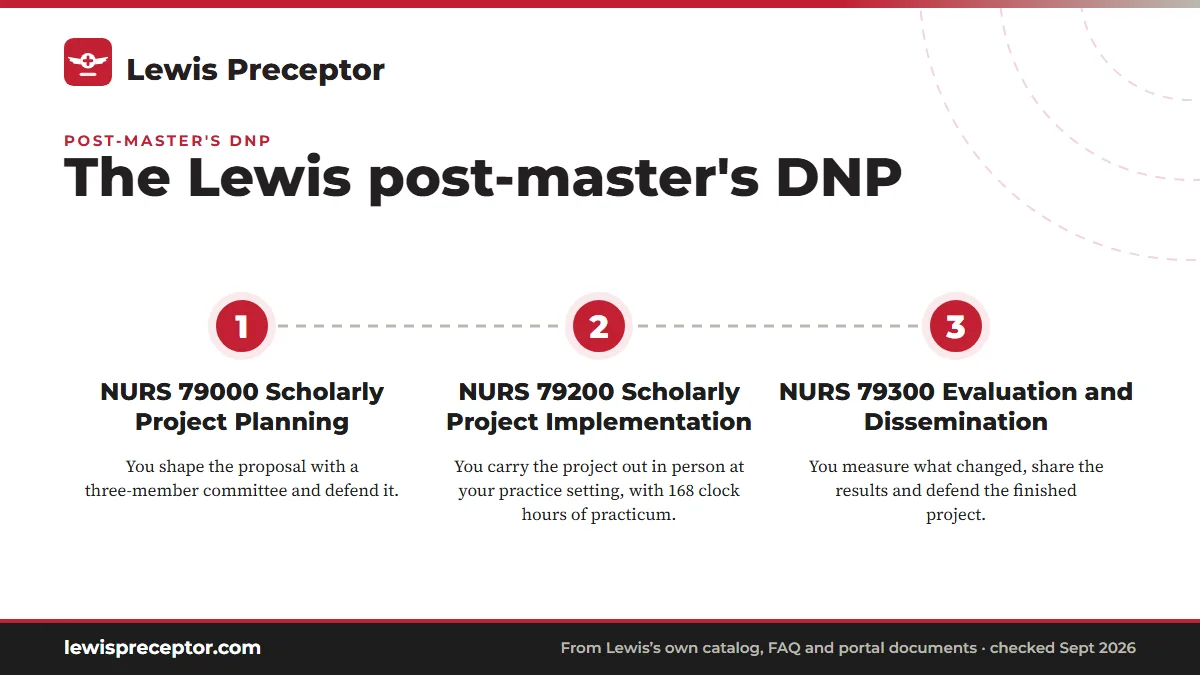
NURS 79000Scholarly Project PlanningYou shape the proposal with a three-member committee and defend it.NURS 79200Scholarly Project ImplementationYou carry the project out in person at your practice setting, with 168 clock hours of practicum.NURS 79300Evaluation and DisseminationYou measure what changed, share the results and defend the finished project.
One of your immersions includes the final project presentation, so the project calendar and the immersion calendar need to line up.
DNP Immersions at Oak Brook
Classes are online, synchronous or asynchronous, yet you cannot graduate without attending two or more DNP Immersions. The DNP web page says these happen once a year at the Oak Brook location, together with Health Assessment lab experiences. What the Oak Brook site holds, and how to get there, is on the Oak Brook campus page.
Lewis does not post immersion dates publicly, so watch your Blackboard courses and your Lewis email for announcements. Because the events are annual and you need two, attend the first one you reasonably can rather than leaving both for your final year. If you live outside the Chicago area, budget the travel time into your work schedule as early as you budget the residency itself.
Where Lewis's DNP pages disagree
Read the DNP web page and you will see a choice of four clinical NP specialty tracks or a leadership track, plus a course in Healthcare Ethics. Read the 2026-27 catalog and there is one 30-credit post-master's program with no tracks and no ethics course. The NP-population route to a doctorate is the BSN to DNP, a separate catalog program.
The course list also carries NURS 79604 DNP Residency, 4 credits, that has no course description and is not required by any Lewis program. The web page also pitches the doctorate to Nursing Education and Healthcare Systems Leadership graduates, while the catalog's admission rule asks simply for an MSN with a specialty focus.
The first program learning outcome is worded differently in the two sources as well. For your plan of study, the catalog is the controlling document; bring anything that affects your residency or project timeline to the Graduate Nursing Program Office before you register.
Choosing a residency setting and preceptor
Lewis's public pages do not say who selects the residency setting or the preceptor. What they do say points to you doing much of the groundwork: the residency is in person at the practice setting you select, your RN license must be in that state, and the learning contract is individual to you. The college's contract portal calls its preceptor contract request mandatory for all students entering clinical practicums, so ask your faculty how and when your residency site goes through it.
A strong setting has three things: a leader or clinician able to guide a doctoral project, a problem the organization already wants solved that matches your essay, and access to the data your evaluation will need. Choosing a site in another state brings Lewis's out-of-Illinois placement policy into play, which can mean added permission from Lewis, from the placement state or from Illinois licensing boards. RN license requirements sets out the license rule for each program. If you hope to run the project inside your own organization, clinicals where you work explains what Lewis has and has not published and what to settle with faculty first.
How we help Lewis DNP students
- Start from your projectWe read your planned focus and the state on your RN license, then look for organizations where that project can realistically run.
- Find the setting and preceptorYour placement advisor approaches practice leaders and clinicians near you and confirms they can support residency blocks of 168 hours and your project implementation.
- Prepare complete detailsWe assemble what your faculty and the contract process need about the site and preceptor, so your learning contract starts from accurate information.
- Stay on callIf a preceptor changes roles or a site pulls back mid-residency, we find a replacement that keeps your project on course.
Describe your project and timeline on the request form and we start with settings in your license state.
Questions Lewis students ask
Is the Lewis DNP fully online?
The coursework is, in synchronous or asynchronous formats. You travel for two things: the Oak Brook immersions (two at minimum), and your residency and project work at the practice site. Lewis reports an 18:1 student-to-faculty ratio for its DNP, and its DNP page lists Health Assessment lab experiences at Oak Brook alongside the immersions.
How long do I have to finish the Lewis DNP?
Five years. The DNP shares the MSN's completion limit, and time on leave still counts against that clock. Lewis has no In Progress grade, so unfinished residency hours at term end mean requesting an Incomplete, and each term has a fixed date to resolve it (March 1 for fall courses). Grades and time limits explains the rules.
Does the Lewis DNP lead to a license?
No. Its March 2026 disclosure says the DNP leads to no separate state license, so the table covers enrollment only, and it authorizes enrollment in the 18 jurisdictions Lewis lists for all its online graduate nursing programs. Your RN and any APRN license rest on your earlier education and certification.
What are the DNP admission requirements?
An ACEN- or CCNE-accredited MSN with a specialty focus, at least two years of RN practice, an unencumbered RN license in your planned residency state, a 3.0 graduate GPA (a 2.75 to 2.99 GPA may mean provisional status), two letters from graduate-prepared professionals with at least one doctoral-prepared, and the 1,000-word project essay. Up to 12 credits can transfer.
Is Lewis's DNP accredited?
Yes. According to CCNE's directory, Lewis's DNP gained accreditation in February 2015; its present term ends December 31, 2030, and CCNE plans its next visit for spring 2030. The catalog's history notes that Lewis's DNP was first approved in 2011, four years before that initial accreditation.
Related pages
Last checked 2026-09-25
We check these pages against Lewis's own catalog, program pages and FAQ, its contract portal and Illinois law. Your course, your track coordinator and the Clinical Placement Office have the final word.
Lewis asks you to identify your preceptor. We do the searching.
Tell us your Lewis program, where you live and when your next practicum starts. We find preceptors near you who fit the course and prepare every detail the contract portal asks for, so your request goes in complete.
- Preceptors matched to the practicum: primary care for
NURS 61100andNURS 61800, acute care forNURS 62500, psychiatric care forNURS 63300 - Preceptor, license and site details ready for your preceptor contract request
- In your own community, anywhere Lewis enrolls you and your RN license is valid
Start your placement plan
Program, city and start date is all we need to begin.