Identifying preceptors: what Lewis asks of NP students
Lewis's MSN FAQ expects nurse practitioner students to identify their own preceptors, while faculty sign off on each match and the Clinical Placement Office steers the paperwork. Below is the passage in full, what each line asks of you, what a finished identification looks like, and how our placement desk does that search for you.
Hand us the search
Tell us your track, your city and your next practicum course.
Lewis's answer, in full
On its graduate nursing FAQ, under the heading "How Do Clinical Placements Work? MSN and CAS NP Tracks," Lewis gives this complete answer:
"The student admitted to the Nurse Practitioner track must complete 540-630 hours of supervised clinical experiences during the program. Students are encouraged to start their practicum planning upon acceptance to the program. For clinical placement, students are expected to be active participants by identifying preceptors and facilitating communication during the process. Students must play an active role. The preceptor and the clinical site must be approved by the Clinical Coordinators and/or Track lead faculty to best meet the needs of the student in the designated course. Our Clinical Placement Office will act as facilitator and the primary point of contact for you in the placement cycle."
Archived copies of the FAQ from February 2023 and July 2024 carry the same wording, so this is a settled position rather than a recent change. It names the MSN and post-master's Certificate of Advanced Study NP tracks. BSN to DNP students take the same practicum courses, so the expectation very likely reaches them too, although the FAQ does not name them.
What each line asks of you
- "540-630 hours": the FNP carries the 630-hour minimum, and the AGACNP, AGPCNP and PMHNP carry 540. Every one of those hours is spent with a preceptor you identified.
- "Upon acceptance": planning begins well before your first clinical course. The acceptance-to-practicum timeline counts back from each start date.
- "Identifying preceptors": you bring Lewis a specific person at a specific agency, not a list of clinics to try.
- "Facilitating communication": you are the link between the preceptor, the agency's staff and Lewis, and you keep questions moving in each direction.
- "Approved by the Clinical Coordinators and/or Track lead faculty": the preceptor's yes opens the door, and faculty then rule on whether the match suits the course. See how approval works.
- "Facilitator and the primary point of contact": the Clinical Placement Office handles the contract side and is where process questions go.
Read as a whole, the passage describes a shared process. The search sits with you; contracting, facilitation and approval sit with Lewis. Lewis has not published what happens when a search comes up empty, which is the strongest reason to begin early.
What a finished identification includes
Identifying is finished when you can fill in the contract request without making another phone call. By that point you should hold:
- A preceptor whose everyday practice matches the course title, such as pediatric primary care for
NURS 64300or psychiatric assessment across the lifespan forNURS 63300. - A yes for the full 16-week semester, with a weekly schedule that can reach the course's hours.
- The preceptor's credentials and license details, checked for discipline with IDFPR or with the board in the state where the site sits.
- The agency's legal name and address, and the person there who signs school agreements.
- Whether the agency runs its own student intake, such as a myClinicalExchange request, and how far ahead it wants it.
- The semester you are requesting, matched to your plan of study.
Miss any of these and the request either will not submit or will stall in review while Lewis asks follow-up questions.
Why the search takes so long
The search is slow for reasons that have little to do with effort. Busy clinics seldom return calls from students, many practices send every student question to a manager, and a preceptor who says yes in the spring can change jobs by the fall.
Large systems add their own layers. According to its NP student page, Advocate does not find preceptors for NP students in Illinois and routes requests through myClinicalExchange. Northwestern Medicine's north and northwest suburbs page takes APRN students only when their school already has an agreement in place, and it wants several weeks of notice.
Fit trips people up too. A preceptor in adult urgent care may suit one course and be wrong for the pediatric or women's health practicum, and faculty judge fit course by course. If a practicum is close and your list is empty, see what to do this week.
A preceptor who says yes is a lead, not a placement. The placement exists only after Lewis's review, faculty approval, a signed agreement where one is needed and the agency's clearance.
How our placement desk handles the identifying
We do the searching you would otherwise squeeze between shifts. We start from your address and work outward, contact practices that match the specific Lewis course, and confirm each preceptor's availability, credentials and site details before we introduce you.
- Course fit first: we read the practicum title, match the practice to it and flag anything your track coordinator should confirm.
- Complete details: you receive the preceptor and agency information in the order the contract request asks for it.
- Timed to Lewis's calendar: we aim to finish months before the semester, so review, any new agreement and onboarding all fit.
- Backup: if a preceptor withdraws, we find the next one and prepare the new details.
Start a search with your track, your city and your next practicum course.
The parts that stay yours
Some steps are yours by design, and a good search makes them lighter rather than replacing them. You create the portal account with your Lewis email and submit the request yourself. You keep CastleBranch current, copy every agency form to the Clinical Placement Office as well as the agency, and answer Lewis's questions during review.
You also plan your own travel. Lewis's University Student Handbook groups nursing clinicals with internships and student teaching as activities where students arrange their own transportation, so a preceptor's distance from home matters. Approval stays with Lewis as well: we present preceptors we expect to fit, and Clinical Coordinators and/or track lead faculty decide. The working relationship is yours too. A clear weekly schedule, your syllabus objectives shared early and prompt replies to the preceptor's office set the tone for the whole semester.
Questions Lewis students ask
Can I use a placement service for my Lewis NP practicum?
Lewis's public pages say nothing for or against outside placement help. What matters to Lewis is the result: a preceptor and site that faculty approve and an agency that signs and clears you. A preceptor we find goes through the same contract request, review and approval as one you find on your own. Compare the two routes.
Does the Clinical Placement Office hand out lists of preceptors?
No public Lewis page says the office keeps a bank of NP preceptors or supplies names. Its published role is facilitation, contracting and being your main contact. It is still worth asking what it knows about sites that have hosted Lewis students in your track, especially sites that already hold an agreement with Lewis.
Who contacts the clinical site about the affiliation agreement?
Lewis does. Its status legend describes Lewis drafting the agreement for any agency without a current one, then holding the request until the agency signs. Your job is to give Lewis the right contact at the agency and keep the preceptor informed, so the paperwork does not sit unnoticed on someone's desk.
How many preceptors will I need across the program?
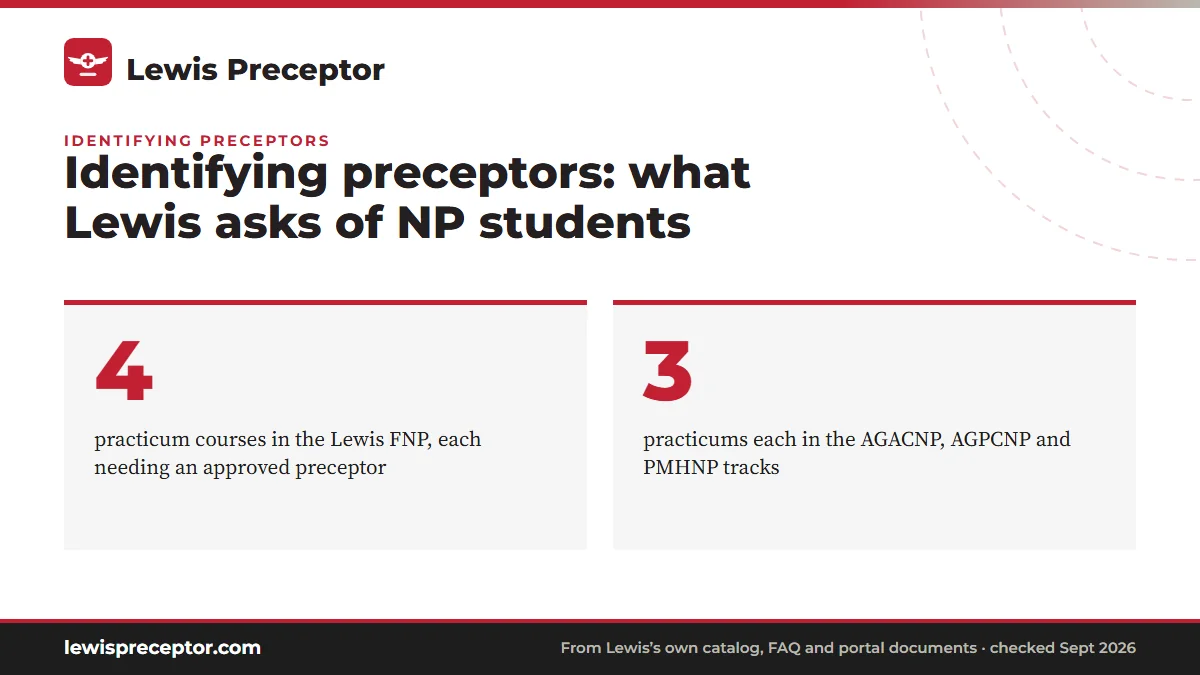
At least one per practicum course: four for the FNP (NURS 61100, NURS 61800, NURS 64100, NURS 64300) and three each for the AGACNP, AGPCNP and PMHNP. Lewis's legend allows a request to name more than one preceptor, which helps when a preceptor works part time. Whether one preceptor may cover two courses is a question for your track coordinator.
Does the FAQ apply to Nursing Education, Leadership or School Nurse students?
The passage speaks to MSN and certificate NP students. Lewis publishes no statement on who arranges practicum sites for Nursing Education (NURS 54700 and the capstones), Healthcare Systems Leadership (NURS 59600) or School Nurse (NURS 56700), though its contract portal covers every clinical practicum. Ask your track coordinator how your practicum is arranged.
Related pages
Last checked 2026-09-25
We check these pages against Lewis's own catalog, program pages and FAQ, its contract portal and Illinois law. Your course, your track coordinator and the Clinical Placement Office have the final word.
- Lewis MSN FAQ: How Do Clinical Placements Work? MSN and CAS NP Tracks
- Lewis contract status legend (2020 PDF, still linked from the portal)
- Lewis University Student Handbook 2026-2027
- Advocate and Aurora: nurse practitioner students
- Northwestern Medicine: APRN student clinical practicum requests, north and northwest suburbs
Lewis asks you to identify your preceptor. We do the searching.
Tell us your Lewis program, where you live and when your next practicum starts. We find preceptors near you who fit the course and prepare every detail the contract portal asks for, so your request goes in complete.
- Preceptors matched to the practicum: primary care for
NURS 61100andNURS 61800, acute care forNURS 62500, psychiatric care forNURS 63300 - Preceptor, license and site details ready for your preceptor contract request
- In your own community, anywhere Lewis enrolls you and your RN license is valid
Start your placement plan
Program, city and start date is all we need to begin.