How a Lewis NP practicum placement comes together
Every Lewis nurse practitioner practicum follows the same path. You identify a preceptor and site, submit a request through the college's preceptor contract portal, Lewis reviews it and sends an affiliation agreement if the agency needs one, faculty approve the fit, the agency clears you, and you start when the semester does. We take on the search at the front of that path and hand you every detail the request asks for.
Map your next practicum
Your track, your city and the semester your practicum starts.
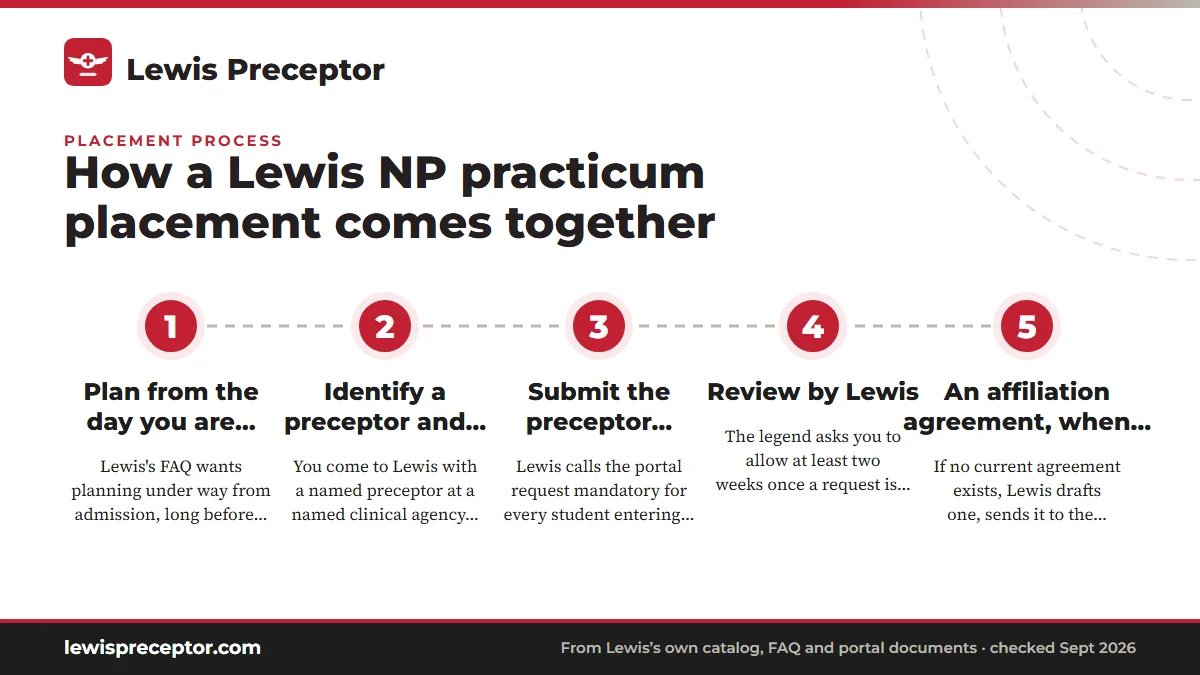
The path from acceptance to your first clinical day
Lewis describes the process in three public places: the MSN FAQ, the contract portal's welcome page and a one-page status legend. Together they give the order below, and each practicum repeats it, because an approval covers one site, the preceptors named on the request and one semester.
- Plan from the day you are admittedLewis's FAQ wants planning under way from admission, long before the first clinical course. Our planning timeline works backward from each practicum.
- Identify a preceptor and siteYou come to Lewis with a named preceptor at a named clinical agency whose practice fits the course. This is the student's part, and the part we do for you.
- Submit the preceptor contract requestLewis calls the portal request mandatory for every student entering a clinical practicum. The account must be created with your Lewis email address, and the portal guide covers the form.
- Review by LewisThe legend asks you to allow at least two weeks once a request is in review, and it says Lewis may contact you to clarify what you entered.
- An affiliation agreement, when the agency has noneIf no current agreement exists, Lewis drafts one, sends it to the agency and waits for the signed copy. Affiliation agreements explains why that wait varies.
- Faculty approvalClinical Coordinators and/or track lead faculty judge whether this preceptor and this site suit that course. The approval page covers what they weigh.
- Agency clearanceWith a contract active, the agency confirms you are cleared to start. Any extra document it requests is sent twice: to the agency and to the Clinical Placement Office.
- Compliance kept currentA lapse in your CastleBranch requirements can cost you the contract at any point, even after approval.
- Your first dayOnce approved, you begin at the named site with the named preceptor or preceptors when the semester on your request starts.
Each practicum runs the path again
FNP students go through these steps four times; AGACNP, AGPCNP and PMHNP students go through them three times. Every NP practicum is a 16-week course taken in the same semester as its paired management course, so a preceptor has to commit to a whole semester, not a short block.
The course title is the clearest signal of the preceptor faculty will expect. The table lists the practicums in the 2026-27 catalog. Hours by course, including the ones where Lewis prints none, are on the clinical hours page.
| Course | Focus in the course title | Tracks |
|---|---|---|
NURS 61100 | Adults in community and primary care | FNP, AGPCNP |
NURS 61800 | Adult/gerontology and adolescents | FNP, AGPCNP, AGACNP |
NURS 64100 | Primary care of women | FNP |
NURS 64300 | Primary care of infants and children | FNP |
NURS 61500 | Adult-gerontology special populations | AGPCNP |
NURS 62500, NURS 62700 | Acute care for adult/gerontology, parts 1 and 2 | AGACNP |
NURS 63300, NURS 63500, NURS 63700 | Psychiatric assessment, psychotherapy and pharmacotherapy across the lifespan | PMHNP |
Post-master's Certificate of Advanced Study students take the same practicums for their track. BSN to DNP students take them first and then move on to the DNP residency, NURS 79600, which Lewis places in person at the selected practice setting.
What Lewis leaves to your course and track
Lewis has no public graduate nursing handbook, NP clinical handbook or preceptor handbook, and its catalog notes that a program's own policies can be stricter than the university's. The practical result: your Blackboard course site, your syllabus and your track coordinator outrank any general guide, including this one.
Not published, and where the answer lives
- A filing deadline, or how many semesters ahead to submit: ask the Clinical Placement Office.
- What happens if no approved preceptor is in place when a practicum begins: raise it with your track coordinator early, not in week one.
- Which preceptor credentials each track accepts: your track coordinator.
- Graduate immunization, TB, BLS and drug-screen details: your CastleBranch package and the agency's onboarding.
- How clinical hours are logged: your course.
- Clock hours for
NURS 64100,NURS 64300andNURS 62700: your syllabus.
Where the process usually slows
Most delays show up at predictable points, and Lewis's own legend points to each of them.
- Blank fields. The form marks required items in red, and a request with anything missing is not reviewed.
- A first-time agency. Without an agreement on file, the request sits in review until the agency signs, and Lewis publishes no limit on how long that takes.
- Onboarding. Hospitals and clinics add their own paperwork, and the request waits on you until the agency clears you.
- Compliance. CastleBranch items that expire mid-semester put an approved contract at risk.
- The preceptor's record. IDFPR discipline against a preceptor is a listed reason to deny. The denial reasons page has the rest.
Two weeks is Lewis's minimum for review, not an estimate of the whole wait. A site that has never hosted a Lewis student adds the agreement on top, and the agency's own onboarding comes after that.
What we handle at each step
Lewis facilitates, contracts and approves. The step before all of that, finding a qualified person willing to precept you for a full semester, is where working nurses lose the most time, and it is the step our placement desk takes over.
- We search your own community for a preceptor whose practice matches the Lewis course title, and confirm availability for all 16 weeks.
- We assemble what the contract request asks for: site and agency details, the contact who handles school agreements, the preceptor's credentials and license, and your semester.
- We check each agency's own student route, such as the myClinicalExchange requests Endeavor Health and Advocate describe on their student pages, and fit it into your timeline.
- We stay with you through review, onboarding and clearance, and line up a replacement if a preceptor has to step away.
The earlier we start, the more room every later step has. Tell us about your next practicum and your placement advisor will plan it against Lewis's semester dates.
Questions Lewis students ask
How long does Lewis take to approve a clinical contract?
Once your request reaches review, Lewis's legend says to expect a minimum of two weeks. Where the agency lacks a current affiliation agreement with Lewis, review lasts until the agency signs one and sends it back, and Lewis gives no typical length for that. Agency onboarding follows. Plan in months rather than weeks, and ask the Clinical Placement Office about your particular site.
Do I need a new contract request for each practicum?
Plan on it. Lewis's legend ties an approval to a specific site, the preceptor or preceptors on the request and the semester you listed, so a different course, site or semester points to a new request. Lewis does not spell this out, so if you are staying with the same preceptor, ask the Clinical Placement Office whether an update is enough.
Can I begin clinical hours before my contract is approved?
Lewis's legend describes the approved status as the point where a student can start at the site, with the named preceptor, once the requested semester begins. Before that point the legend does not describe you as cleared. Your course faculty make the call, so confirm your start with them before you spend any time at the site.
What happens if my preceptor cancels partway through the semester?
Under Lewis's legend, a cancellation by any party, whether agency, preceptor, student or Lewis itself, turns the contract inactive. Lewis does not publish what follows for your course, so let the Clinical Placement Office and the faculty teaching your course know that day. If we placed you, your placement advisor starts the replacement search at once and prepares the details for a new request.
Does the same process apply to DNP residencies?
Lewis calls its contract request mandatory for every student entering a clinical practicum. DNP residency (NURS 79600) and project implementation (NURS 79200) take place in person at a practice setting, guided by an individualized learning contract with a preceptor and a faculty member. Lewis does not say who selects that setting, so ask your DNP faculty early.
Related pages
Last checked 2026-09-25
We check these pages against Lewis's own catalog, program pages and FAQ, its contract portal and Illinois law. Your course, your track coordinator and the Clinical Placement Office have the final word.
Lewis asks you to identify your preceptor. We do the searching.
Tell us your Lewis program, where you live and when your next practicum starts. We find preceptors near you who fit the course and prepare every detail the contract portal asks for, so your request goes in complete.
- Preceptors matched to the practicum: primary care for
NURS 61100andNURS 61800, acute care forNURS 62500, psychiatric care forNURS 63300 - Preceptor, license and site details ready for your preceptor contract request
- In your own community, anywhere Lewis enrolls you and your RN license is valid
Start your placement plan
Program, city and start date is all we need to begin.