Why a Lewis clinical contract gets denied, and how to keep yours clean
Lewis's contract legend names five things that can sink a preceptor contract: wrong or missing information, IDFPR discipline against the preceptor, unsafe conduct by the preceptor or agency, a CastleBranch compliance lapse, and an agency revoking its contract with Lewis. A denial can come at any stage, even after approval. Most of the five can be headed off before you ever press submit.
Get your placement plan
Tell us your Lewis program and where you live. A placement advisor replies with preceptor and site options in your community that fit your Lewis course.
How denial works in Lewis's process
Lewis's legend treats denial as something that can happen to any request at any point: during review, after review, and even once approval has been granted. When it happens, Lewis tells you through your Lewis email. The reasons are introduced as "Some things that may result in denial," so read them as the usual causes rather than a closed list.
That legend is a one-page PDF dated 2020, and the live contract portal still links to it. It is the only public Lewis document that explains denial at all, which is why this page leans on it. For the full run of statuses a request passes through, see the contract portal guide. This page stays with the ways a contract ends early and how to prevent each one.
The five reasons, side by side
The first column quotes the legend, which spells the vendor's name as two words. The other two columns are our practical reading.
| Reason in the legend | Where it usually starts | How to head it off |
|---|---|---|
| "Incorrect or incomplete information" | A site name, address, preceptor detail or semester that does not match reality | Verify every entry with the agency and the preceptor before submitting |
| "Preceptor discipline from IDFPR" | A disciplinary action on the preceptor's record with Illinois's licensing regulator | Check the preceptor's license record before the name goes on your request |
| "Unsafe or questionable conduct of preceptor or clinical agency" | Concerns about how a preceptor or site practices, raised before or during the rotation | Choose established preceptors and raise concerns with the Clinical Placement Office early |
| "Student’s lack of compliance with Castle Branch requirements" | A missing upload, or an item that expires mid-semester | Clear the whole package early and track every expiration date |
| "Clinical agency revocation of clinical contract with Lewis University" | The agency ends its contract with Lewis | Nothing you can prevent; know your second-choice site |
Wrong or missing details: the reason you fully control
Two different statuses deal with bad information, and they are easy to mix up. A form with empty required fields never reaches a reviewer; it waits at Missing Info. A form that is complete but wrong can move forward and then be denied, and the legend adds that it may stay denied until you correct it. In between, a reviewer may contact you to clarify, and every inaccuracy slows the request down.
The usual culprits are ordinary: a clinic's trade name in place of its legal one, a suite number that changed, a credential typed from memory, the wrong semester. None of them reflects on you as a student, and each is far cheaper to catch before submission than after. The placement desk gathers every detail straight from the agency and the preceptor and hands it to you ready to enter, which is the heart of how we work.
Reasons tied to the preceptor or the agency
Lewis looks at the people and places you propose. Discipline from IDFPR, the Illinois Department of Financial and Professional Regulation, can lead to a denial, and so can unsafe or questionable conduct by the preceptor or the clinical agency. Lewis does not publish a preceptor credential list by track, so these screening grounds plus faculty approval are the public standard; preceptor requirements gathers what is known.
The practical defense is to vet before you ask. A preceptor with a clean license record, a settled role at the site and a caseload that matches your course gives reviewers nothing to question. Agency revocation works differently: if a site ends its contract with Lewis, your approval goes with it, however good your paperwork. You cannot prevent that one. You can only be ready with a second option, and staying on call for exactly that moment is part of our service.
CastleBranch lapses after approval
The CastleBranch reason catches students who did everything else right. Because Lewis can deny a contract even after approving it, an item that expires in week ten of a 16-week practicum can put the rest of your hours at risk. Graduate item lists are not public; they come with your CastleBranch package and from your agency.
Treat compliance as a job that lasts all semester. Before a practicum begins, hold every expiration date in your record up against the last day of the term, renew anything that would lapse, and keep proof of each renewal. When an agency asks for extra documents, the legend has you send them to the agency and to the Clinical Placement Office. What the package holds and who pays for it is on CastleBranch at Lewis.
When a contract goes Inactive instead
Inactive is not a denial. The legend reserves it for a contract that has been cancelled, and the cancellation can come from four directions: the agency, the preceptor, the student or Lewis University. A preceptor who changes jobs, a practice that stops taking students, or a plan you change yourself can each leave a contract Inactive.
For your practicum, the effect matches a denial: no active contract at that site, and no basis for logging more hours there. What decides the outcome is speed. A cancellation in week three leaves room to recover; the same news discovered in week eight may not. Stay in regular touch with your preceptor so that a job change reaches you early, not at the door of your next shift.
What to do the day a denial or cancellation arrives
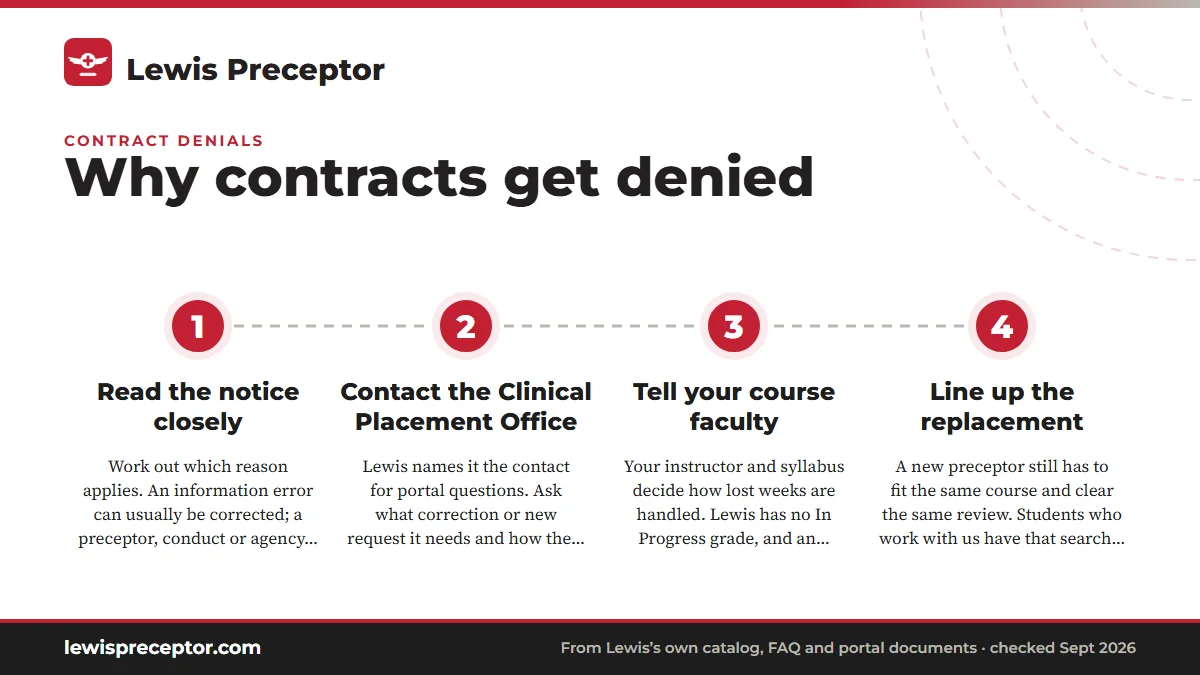
- Read the notice closelyWork out which reason applies. An information error can usually be corrected; a preceptor, conduct or agency problem usually means a different match.
- Contact the Clinical Placement OfficeLewis names it the contact for portal questions. Ask what correction or new request it needs and how the timing affects your course.
- Tell your course facultyYour instructor and syllabus decide how lost weeks are handled. Lewis has no In Progress grade, and an Incomplete requires that you be passing; see grades and incompletes.
- Line up the replacementA new preceptor still has to fit the same course and clear the same review. Students who work with us have that search running right away.
Questions Lewis students ask
Can I fix a denied Lewis contract request, or do I start over?
It depends on the reason. For incorrect information, the legend describes a denial that holds until the student corrects the details, which points to fixing and resubmitting. For preceptor discipline, conduct concerns or an agency revocation, a new preceptor or site is usually the realistic route. The Clinical Placement Office can tell you which path your case needs.
Can Lewis deny my contract after I have started my hours?
Yes. The legend allows a denial at any point, even after approval has been granted. Two ways that can happen without much warning are a compliance item expiring mid-semester and a site ending its contract with Lewis. Keep your CastleBranch record current to the last day of the term and stay in close contact with your preceptor.
How can I check a preceptor's license before I submit?
Ask the preceptor for their license type, number and issuing state, then look the license up with the board that issued it; in Illinois that is IDFPR, the regulator Lewis's legend names. Confirm the license is active and look for any disciplinary action. The placement desk runs this check on every preceptor it presents to a Lewis student.
Does a denied or inactive contract hurt my standing in the program?
Lewis's public pages do not link a denied or inactive contract to academic standing. What matters academically is completing the practicum hours within the course, because Lewis has no In Progress grade and MSN and DNP students must finish within five consecutive years. Move quickly on a replacement and keep your course faculty informed.
What if my preceptor is licensed outside Illinois?
The legend names IDFPR, Illinois's regulator, and says nothing about boards in other states. A clean record with the board where your preceptor practices is the sensible standard to hold them to. Placements outside Illinois can also need extra permission, which is covered on clinicals outside Illinois. If you are still searching, start with no preceptor yet.
Related pages
Last checked 2026-09-25
We check these pages against Lewis's own catalog, program pages and FAQ, its contract portal and Illinois law. Your course, your track coordinator and the Clinical Placement Office have the final word.
Lewis asks you to identify your preceptor. We do the searching.
Tell us your Lewis program, where you live and when your next practicum starts. We find preceptors near you who fit the course and prepare every detail the contract portal asks for, so your request goes in complete.
- Preceptors matched to the practicum: primary care for
NURS 61100andNURS 61800, acute care forNURS 62500, psychiatric care forNURS 63300 - Preceptor, license and site details ready for your preceptor contract request
- In your own community, anywhere Lewis enrolls you and your RN license is valid
Start your placement plan
Program, city and start date is all we need to begin.