What a placement service should do for a Lewis student
A good service does far more than pass along a name. For a Lewis student it should match the preceptor to the exact practicum course, deliver every detail the contract request asks for, keep CastleBranch and agency onboarding moving, check your state's rules, and replace a preceptor quickly if one drops. Put the questions below to any service you consider, ours included.
Get your placement plan
Tell us your Lewis program and where you live. A placement advisor replies with preceptor and site options in your community that fit your Lewis course.
It should already know Lewis's path
Any service worth your time should know how a Lewis practicum is set up before you explain it: you identify the preceptor, submit a request in the College of Nursing and Health Sciences contract portal, Lewis reviews it and drafts an affiliation agreement where one is missing, Clinical Coordinators and/or track lead faculty approve, and the agency clears you. A service that speaks only in general terms leaves the Lewis-specific work with you.
Lewis publishes no list of placement companies and takes no public position on them. A claim that Lewis refers students to a service, partners with it or moves its preceptors through faster is therefore a warning sign. The placement process shows each Lewis step in order.
Fit to the exact course
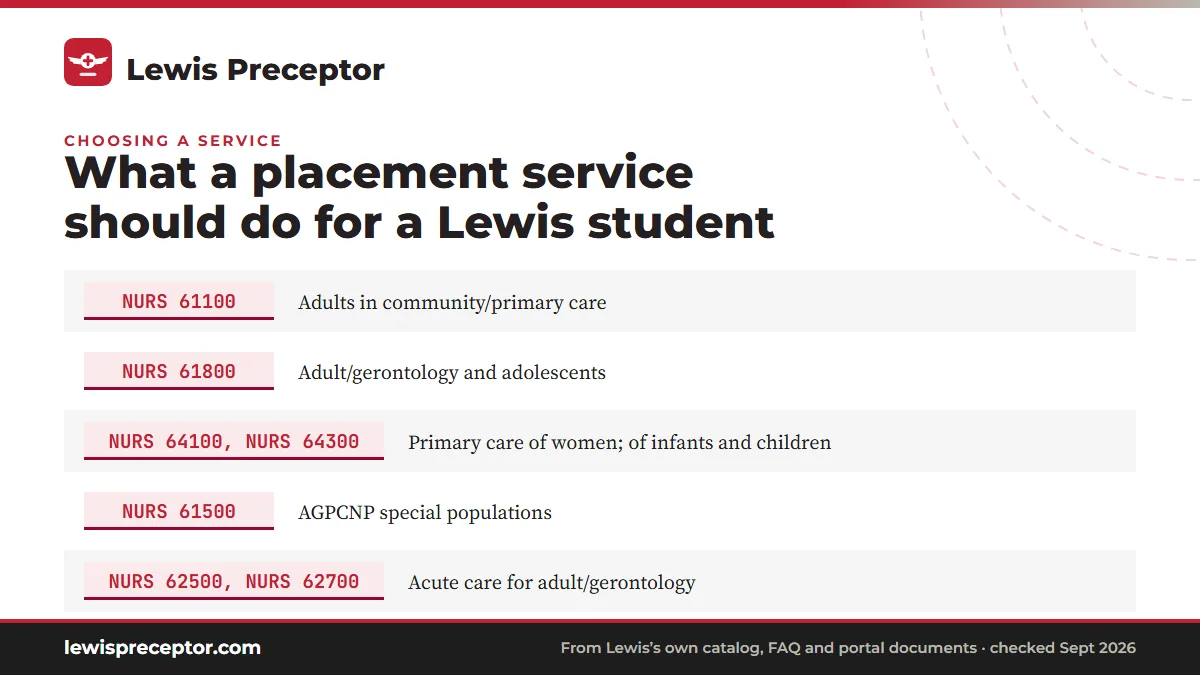
Lewis approves a preceptor for a particular course, so fit is the first test. Ask how the service reads your course title, and listen for specifics rather than a promise of any available NP.
| Course | Title focus | A careful search targets |
|---|---|---|
NURS 61100 | Adults in community/primary care | Adult primary care or community practice |
NURS 61800 | Adult/gerontology and adolescents | A practice that sees older adults and teenagers |
NURS 64100, NURS 64300 | Primary care of women; of infants and children | Women's health primary care; pediatric primary care |
NURS 61500 | AGPCNP special populations | Settings your track coordinator accepts for this course |
NURS 62500, NURS 62700 | Acute care for adult/gerontology | Hospital services, with the hospital's own student intake |
NURS 63300, NURS 63500, NURS 63700 | Psychiatric care across the lifespan | Psychiatric practices seeing patients of many ages |
A careful service also knows where Lewis's pages disagree, such as the 360 hours in NURS 62500's description against the 540-hour AGACNP total, and routes those questions to your track coordinator instead of guessing.
Details ready for the contract request
The portal flags required fields in red and leaves a request with blanks unreviewed, and Lewis's legend lists wrong or incomplete information as grounds for denial. A service worth hiring hands over a finished set: the preceptor's name, credentials and license with the discipline lookup done, the agency's legal name and address, the person there who signs school agreements, the semester, and the preceptor's weekly days across 16 weeks.
Ask to see a sample handoff before you commit, with personal details removed. If what arrives is a name and a clinic number, the vetting, the chasing and the agreement questions all remain yours. What happens after you submit is covered in the contract portal guide.
CastleBranch and agency onboarding
Lewis's legend names a lapse in CastleBranch requirements as a reason a contract can be denied, even after approval, and it directs any document an agency asks for to both the agency and the Clinical Placement Office. A good service helps you track both: which items the agency wants, when each one expires against the semester, and whether copies reached both places.
It should also know each agency's own route. According to their student pages, Endeavor Health and Advocate take student requests through myClinicalExchange, and Northwestern Medicine accepts APRN students in its north and northwest suburbs only from schools holding a current agreement. You keep your own records; the service keeps the timeline in view so nothing lapses. CastleBranch at Lewis explains the record itself.
Your state and your license
Lewis authorizes online graduate nursing enrollment in 18 jurisdictions, and its 2026 disclosures add a licensure column that varies by program. The MSN NP and BSN to DNP tables mark Hawaii, Indiana, Massachusetts and Mississippi as not meeting licensure requirements, while the certificate tables name Connecticut, Indiana, Massachusetts and Mississippi. The graduate catalog adds that placements outside Illinois may need permission from Lewis, the placement state or Illinois licensing boards.
Your RN license matters as well. MSN admission rests on a license in Illinois or your state of practice, BSN to DNP students need one in Illinois and/or the practicum state, and DNP students need one where the residency takes place. A good service asks where you live and hold a license before it searches, and flags questions for your advisor. More on clinicals outside Illinois.
A real plan for replacement
Preceptors leave, and a service shows its quality in that moment. When a preceptor or agency cancels, Lewis's portal marks the contract Inactive, and the replacement needs a new request, a review of at least two weeks and perhaps a new agreement. Ask any service what happens next: who searches, how soon, and whether the new preceptor's details come prepared the same way as the first.
Ask too how it plans the rest of your program. FNP students need an approved preceptor for each of four practicums, and AGACNP, AGPCNP and PMHNP students for each of three. A service that plans only one semester at a time leaves the next search starting late.
Questions to put to any service
- Which Lewis course is this search for, and what kind of practice fits it?
- What exactly will I receive before I file the contract request?
- How do you check a preceptor's license and discipline record?
- How do you handle agency intake and CastleBranch timing?
- Have you checked my state against Lewis's enrollment and licensure tables?
- What happens if my preceptor drops out mid-semester?
- What does the fee include, in writing?
Be cautious with any answer that promises approval, a start date or special standing with Lewis. Only Lewis approves a preceptor, and only the agency clears you to begin. A clear, specific answer to each question above is the best sign that a service knows Lewis.
How we answer those questions
We built our service around Lewis's process, so each answer above is part of our routine. We read your practicum course before searching, look close to your home, secure the full 16 weeks, check the license, and hand you the agency and preceptor details in one set ready for the portal. We track agency onboarding and CastleBranch dates with you, check your state first, and open a replacement search the day a preceptor steps back. Lewis keeps every decision throughout: we present preceptors we expect to fit, and faculty and the agency decide. See how it works or start with the form.
Questions Lewis students ask
Does Lewis recommend a preceptor placement service?
No public Lewis page recommends, approves or bans a placement company, and none is named. Lewis's process is the same for every student: a contract request, review, faculty approval and agency clearance. Treat any service's claim of a Lewis connection with caution, and judge it on the work it does for your course.
Should a service find me a preceptor in another state?
Only after your state checks out. Lewis enrolls online graduate nursing students from 18 jurisdictions, some with licensure caveats that differ by program, and warns that out-of-state placements may need extra permission. A service should confirm your state and license first, then search locally, with open questions going to your advisor before any site is promised.
What should a placement service cost?
Prices vary with the course, the area and how soon the semester begins, so compare what is included rather than one figure. Ask whether replacement searches, agency intake help and later practicums are covered, and get it in writing. Our cost page explains what shapes the price of a placement.
Can a placement service promise my preceptor will be approved?
No honest one can. Clinical Coordinators and/or track lead faculty approve every Lewis preceptor and site, and the agency decides when you are cleared. What a service can promise is its own work: a preceptor matched to the course, details checked and complete, and a quick replacement if one is needed.
Should I use a service for every practicum or just one?
Either can work. Some Lewis students search on their own for a common setting and bring in help for a narrow one, such as pediatric primary care for NURS 64300 or a psychiatric practicum. Others want one plan covering every practicum. Own search vs placement help weighs the two routes.
Related pages
Last checked 2026-09-25
We check these pages against Lewis's own catalog, program pages and FAQ, its contract portal and Illinois law. Your course, your track coordinator and the Clinical Placement Office have the final word.
- Lewis contract status legend (2020 PDF, still linked from the portal)
- Lewis MSN FAQ: How Do Clinical Placements Work? MSN and CAS NP Tracks
- Lewis accreditation and professional licensure disclosures
- Lewis graduate academic policies: placements outside Illinois (2026-27 catalog)
- Endeavor Health: nursing clinical rotations
Lewis asks you to identify your preceptor. We do the searching.
Tell us your Lewis program, where you live and when your next practicum starts. We find preceptors near you who fit the course and prepare every detail the contract portal asks for, so your request goes in complete.
- Preceptors matched to the practicum: primary care for
NURS 61100andNURS 61800, acute care forNURS 62500, psychiatric care forNURS 63300 - Preceptor, license and site details ready for your preceptor contract request
- In your own community, anywhere Lewis enrolls you and your RN license is valid
Start your placement plan
Program, city and start date is all we need to begin.