The Lewis FNP's 630 clinical hours, course by course
The Lewis MSN Family Nurse Practitioner track requires at least 630 hours of clinical experience, earned across four 16-week practicums. Two of those courses print 180 clock hours apiece. The women's health and pediatric practicums print none, so the rest of the 630 has to be read from the catalog's structure rather than from a figure Lewis states.
Plan all four FNP preceptors
Share your town and the term your next FNP practicum starts. We map a preceptor to each of the four courses.
NURS 61100 and NURS 61800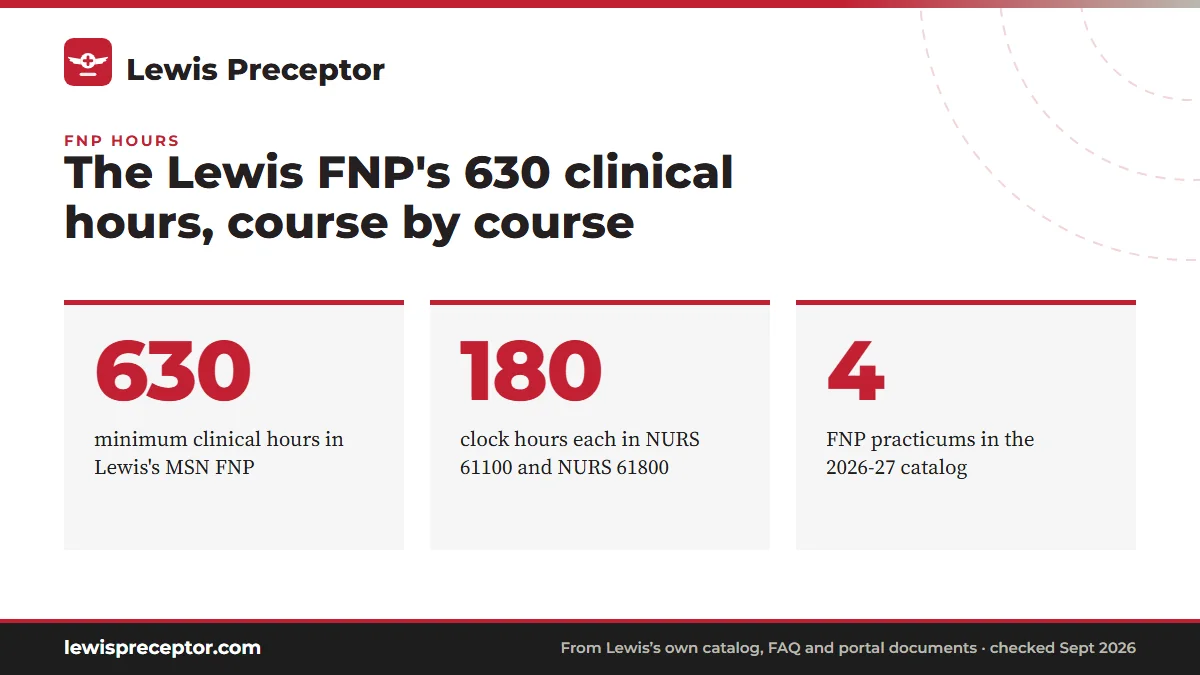
The four FNP practicums at a glance
Every FNP practicum is a 16-week course tied to a management course. This is how the 2026-27 catalog lists them, with the hours it prints and the gaps it leaves.
| Practicum | Title | Linked management course | Credits | Clock hours printed |
|---|---|---|---|---|
NURS 61100 | NP Practicum: Adults in Community/Primary Care | NURS 61000, same semester | 3 | 180 |
NURS 61800 | NP Practicum: Adult/Gerontology and Adolescents | NURS 61200, same semester | 3 | 180 |
NURS 64100 | Family Nurse Practitioner Practicum: Primary Care of Women | NURS 64000, listed as a prerequisite | 2 | None |
NURS 64300 | Family Nurse Practitioner Practicum: Primary Care of Infants & Children | NURS 64200, listed as a prerequisite | 2 | None |
| Whole track | MSN Family Nurse Practitioner | 48 | 630 minimum |
The course list shows credit ranges for some of these (2 to 3 for NURS 61100, 1 to 3 for NURS 61800, 1.5 to 2 for the women's and pediatric pair), while the FNP program table fixes them at the values above, the ones that add up to 48. The first two courses have their own guides: NURS 61100 and NURS 61800.
What Lewis states in writing
Three statements anchor the FNP's hours. The catalog's FNP program page requires a minimum of 630 hours of clinical experience. The MSN FAQ describes the track as 48 credit hours plus 630 clinical hours. And the course descriptions for NURS 61100 and NURS 61800 each print 180 clock hours of practicum.
The same catalog says nurse practitioner specialization courses are offered in a traditional 16-week format, while the MSN core runs in 8-week sessions. Each FNP practicum therefore fills a whole semester, and each needs a preceptor approved before that semester opens.
One wording quirk is worth knowing. The NURS 61100 description calls it the first of three clinical courses. Three matches the AGPCNP's practicums, and it matched the FNP too until the 2024-25 catalog's women's and children's practicum was split in two. Current FNP students take four, and the program table is the requirement that counts.
The 270 hours Lewis leaves unassigned
NURS 64100 Primary Care of Women and NURS 64300 Primary Care of Infants & Children print credits but no clock hours. Take the two printed practicums away from the program minimum and 270 hours remain: 630 minus 180 minus 180.
That 270 has a history. The archived 2024-2025 graduate catalog used a single course, NURS 61700 FNP Practicum: Primary Care of Women, Infants and Children, at 270 clock hours of practicum. The 2026-27 catalog splits that content into two practicums and keeps the 630 total. NURS 61700 still appears in the course list, but no current program requires it.
Halving 270 gives 135 per course. That is our arithmetic, not Lewis's figure, and Lewis may weight the two courses differently. The syllabus for each course and your track coordinator hold the real number, and the women's health and pediatric practicum guide covers the preceptors those two courses need.
Get the hour figure for NURS 64100 and NURS 64300 from the course itself before you and a preceptor agree on a schedule. A plan built on an estimate of 135 can come up short late in the semester, when there is little room left to add clinic days.
How the 630 hours fall across your semesters
The practicums come after the groundwork. The management courses paired with them require the MSN core courses NURS 51700, NURS 53300, NURS 53400, NURS 53600 and NURS 55900, plus NURS 60400 pharmacotherapeutics, NURS 60500 physiology and pathophysiology, and NURS 60700 health assessment. Clinical hours begin once that foundation is complete.
Inside the practicum stretch, the catalog fixes a few links. NURS 61100 runs with NURS 61000, and NURS 61800 with NURS 61200. The women's and pediatric practicums instead name their management courses, NURS 64000 and NURS 64200, as prerequisites. Lewis publishes no semester-by-semester FNP plan, so confirm your order with your advisor; the 16-week course guide shows how the pairings sit on the calendar.
Whatever the order, you have five consecutive years from enrolling in graduate coursework to finish every MSN requirement, and a leave of absence does not extend that clock.
The same 630 in the certificate and BSN to DNP
The FNP Certificate of Advanced Study, at 30 credits, drops the MSN core but keeps all twelve NP courses, the four practicums included. Its hours follow the MSN: the FAQ's range for certificate NP tracks runs from 540 to 630, and the FNP's course list is the one that reaches 630. Transfer credit, capped at 12 credits, covers didactic courses such as health assessment or pharmacology, not practicums.
BSN to DNP students on the FNP track take the same eight FNP specialty courses, 20 credits inside a 75-credit program, before moving into the DNP block. Lewis prints no hour total for that path. Adding 630 to the DNP's 504 residency hours gives 1,134, which is arithmetic rather than a Lewis figure. Both routes still need a preceptor for each of the four FNP practicums, unless faculty approve one preceptor for more than one course.
Questions to settle before your first FNP practicum
Lewis's public pages leave several practical hour questions open. Put them to your course faculty or track coordinator early, and keep the answers in writing.
- How many hours
NURS 64100andNURS 64300each require, and whether one family practice may supply both. - Whether any hours can be indirect, since no public source defines a direct and indirect split.
- Where hours are logged. No public Lewis page names the platform.
- Whether one practicum's hours may be split across two sites.
- How far ahead to file each preceptor contract request. Lewis allows a minimum of two weeks for review, longer when an agency needs a new affiliation agreement; the contract portal guide explains each status you will see.
Four practicums, one plan from our placement desk
The FNP has more practicums than any other Lewis MSN track: four of them, each approved for its own course, covering adult primary care, adolescents through older adults, women's health and pediatrics. Our placement desk plans all four together. We search your community for preceptors whose practice fits each course, check that license and site details are in order, and give you the complete information set the contract portal asks for.
Where one family practice could cover more than one course, we point it out so you can raise it with faculty, which can mean fewer agencies to clear. Where it cannot, we line up separate women's health and pediatric preceptors early, so no semester opens without one. The FNP track guide covers the program as a whole, the hours overview compares every Lewis track, and the contact form starts your plan.
Questions Lewis students ask
Is the Lewis FNP 540 or 630 clinical hours?
630. The 540 figure belongs to the AGACNP, AGPCNP and PMHNP tracks. The mix-up usually starts with the MSN FAQ, which describes every Lewis NP track with a single 540 to 630 range. The FNP sits at the top of that range because its four practicums add women's health and pediatrics, and the FNP certificate follows the same course list.
How many pediatric clinical hours does the Lewis FNP require?
Lewis prints no hour figure for NURS 64300 Primary Care of Infants & Children, and no public source sets a minimum count of pediatric hours. The older catalog folded pediatrics into the 270-hour NURS 61700 alongside women's health. Ask your course faculty for the current requirement rather than dividing 270 in half on your own.
Do hours from my RN job count toward the 630?
No public Lewis page says so. The FAQ describes NP hours as supervised clinical experiences completed during the program, and the catalog ties them to practicum courses with a preceptor and site approved for that course. RN shifts, however many, are a different role. Your track coordinator can confirm how your hours are verified.
Did the FNP hour total change when Lewis split NURS 61700?
The total held steady: both the 2024-25 and 2026-27 catalogs require 630. What changed is the structure. One 270-hour practicum on women, infants and children became NURS 64100 and NURS 64300, each worth 2 credits with its own management course, and the new descriptions leave clock hours out.
Can one preceptor cover all four FNP practicums?
Lewis publishes no rule for or against it. Approval runs course by course, with faculty signing off on a preceptor and site as the right fit for the designated course, and each request names its semester. A family practice that sees adults, women and children may suit several courses; a pediatric or women's health specialist usually fits one. Raise the idea with your track coordinator early.
Related pages
Last checked 2026-09-25
We check these pages against Lewis's own catalog, program pages and FAQ, its contract portal and Illinois law. Your course, your track coordinator and the Clinical Placement Office have the final word.
Lewis asks you to identify your preceptor. We do the searching.
Tell us your Lewis program, where you live and when your next practicum starts. We find preceptors near you who fit the course and prepare every detail the contract portal asks for, so your request goes in complete.
- Preceptors matched to the practicum: primary care for
NURS 61100andNURS 61800, acute care forNURS 62500, psychiatric care forNURS 63300 - Preceptor, license and site details ready for your preceptor contract request
- In your own community, anywhere Lewis enrolls you and your RN license is valid
Start your placement plan
Program, city and start date is all we need to begin.