Lewis BSN clinicals
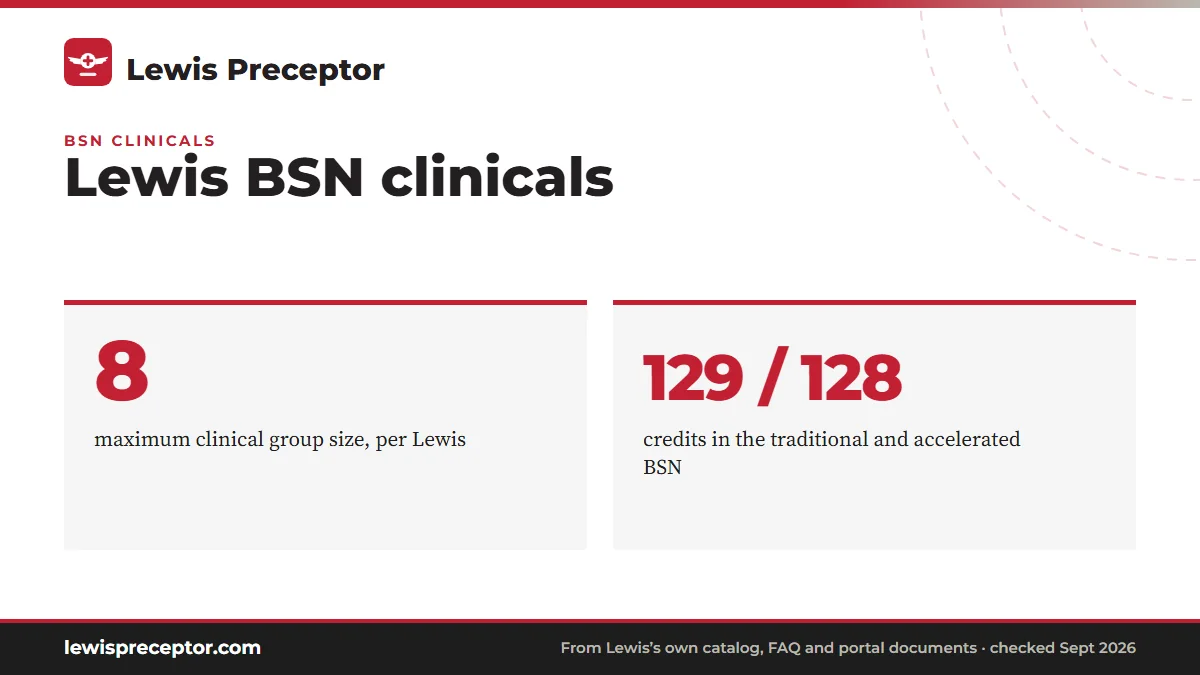
Lewis arranges clinicals for its traditional and accelerated BSN students at affiliating agencies, in clinical groups it caps at eight. Nothing Lewis publishes asks BSN students to find their own sites. The one precepted experience is the senior role transition course, NURS 43900, and that course, plus planning for what comes after it, is where our help fits.
Plan your senior year and beyond
Tell us your level, your campus and what you are planning next.
How Lewis places BSN students
Lewis's clinical sites page describes a network of affiliating agencies and advertises a maximum clinical size of 8. In practice that means faculty-led groups rotating through hospitals and community settings that Lewis has agreements with. When Lewis's college pages talk about placing students with healthcare partners, they are describing this BSN model.
How many agencies depends on which Lewis page you read: the undergraduate catalog lists 62, the clinical sites page lists 49 and the BSN page says students select from 50. Names on those lists include Advocate Christ Medical Center, Silver Cross Hospital, Edward Hospital, Northwestern Medicine Central DuPage Hospital, UChicago Medicine AdventHealth, the Edward Hines Jr. VA and the Will County Health Department, in Lewis's home county of Will County.
Lewis tells students to consult their advisor for the most current listing, and some entries are dated. Ascension Saint Joseph in Joliet, for example, is now Saint Joseph Medical Center, owned by Prime Healthcare since March 2025, and Edward Hospital is part of Endeavor Health.
Which BSN courses carry clinicals
Rather than clock hours, Lewis publishes which courses carry a clinical, lab, simulation or community component and when each falls. The traditional BSN moves by level; the accelerated BSN compresses the same courses into five semesters of 8-week blocks.
| Course | Clinical component | Traditional level | ABSN semester |
|---|---|---|---|
NURS 23300 Health Assessment Across the Lifespan | Lab and simulation | Sophomore 2 | 1 |
NURS 23200 Fundamentals of Safety and Quality in Patient-Centered Care | Lab and clinical, adult and older adult | Sophomore 2 | 1 |
NURS 32900 Health Promotion and Disease Prevention Across the Lifespan | Community rotation: health fairs, shelters, schools, clinics | Junior 1 | 2 |
NURS 32500 Adult 1: Beginning | Acute medical-surgical | Junior 1 | 2 |
NURS 33800 Childbearing Families | Simulation, antepartum, intrapartum, postpartum, neonatal | Junior 2 | 3 |
NURS 33700 Children, Adolescents, and Families | Inpatient, outpatient, community | Junior 2 | 3 |
NURS 42500 Adult 2: Advanced | Acute care | Senior 1 | 4 |
NURS 42700 Psychiatric and Mental Health Nursing | Adults 18 and over | Senior 1 | 4 |
NURS 43500 Adult 3: Critical Care | High acuity | Senior 2 | 5 |
NURS 43600 Community Health Nursing | Community settings | Senior 2 | 5 |
NURS 43900 Professional Development 4: Role Transition | Precepted acute care clinical, plus NCLEX review | Senior 2 | 5 |
Clearance before Sophomore 2
Before your first clinical course, Lewis requires a disclosure form similar to the one IDFPR uses in the RN license application, a completed physical examination form and the required immunizations. Drug screening, a background check and a flu shot are yearly, due every consecutive fall and before Sophomore 2 clinical courses. To be placed in a clinical agency, you must have no findings for misdemeanors or felonies on an FBI fingerprint background check, and every CONHS student is subject to the college's Chemical Impairment Policy.
Agencies can add their own requirements on top of Lewis's, and getting to them is on you: the University Student Handbook lists nursing clinicals among the activities for which Lewis does not ordinarily provide transportation. A reliable car, or a realistic transit plan, matters from Sophomore 2 onward. Clinical compliance requirements explains clearance in more depth.
The senior preceptorship in NURS 43900
NURS 43900 Professional Development 4: Role Transition closes both the traditional and accelerated sequences, in Senior 2 or the second half of semester 5. It pairs a precepted acute care clinical (NURS 43902) with NCLEX review, and the catalog says students collaborate with a preceptor and a faculty member to reach course objectives and individualized learning goals.
The catalog does not describe how senior preceptors are matched, and the BSN Nursing Student Handbook that holds those policies is not posted publicly. Ask your course faculty early how they gather student preferences, if they do. A clear, early request naming the unit or specialty you hope for, with a short reason tied to your career plan, gives faculty something concrete to weigh alongside the agency's capacity.
The clinical-group model is a BSN arrangement. Lewis's graduate NP tracks work differently: there, Lewis's FAQ asks students to take an active part in identifying their own preceptors, which is a very different job from the one you do as an undergraduate.
Accelerated BSN: the same clinicals, faster
The accelerated BSN has two pathways, First Degree Completion and Second Degree Career Transition, at 128 credits with 64 in nursing and a 3.0 GPA. Lewis describes it as six semesters: a pre-term plus five semesters of clinicals, or seven to eight semesters part time. Courses run in 8-week blocks by day, with evening and weekend options, hybrid and in person at Lewis University at Oak Brook and at St. Augustine College in Chicago, and you can move to the 16-week program if you need more time.
The traditional BSN is 129 credits with 64 in nursing, and a 2.75 GPA is needed to register for Sophomore 2 nursing courses. Lewis's own admission pages disagree in places: one still shows a 2.75 GPA and the Kaplan test for the accelerated route, a figure that matches an older, closed track, and the transfer GPA appears as 2.75 in the catalog but 3.0 on the BSN page. Follow the catalog and confirm with admissions.
Where our help fits for BSN students
Lewis places your BSN clinical groups, and that stays with Lewis and its faculty. Our role for BSN students is narrower and looks ahead:
- Senior preceptorship questions: what
NURS 43900expects of you, how to prepare for a precepted acute care rotation and what to ask faculty about unit preferences - Clearance planning: a calendar for the yearly drug screen, background check and flu shot so nothing lapses before a rotation
- The Silver Cross Hospital Partnership: Lewis's partnership offers BSN graduates loan repayment support and mentoring in return for a four-year commitment, and a clinical rotation at the hospital is one qualifying route
- Graduate plans: Lewis BSN seniors may apply to the MSN before holding an RN license, as long as they are licensed by the end of the first graduate semester and practicing by the end of the second, and we start an NP preceptor plan early for students taking that step
If an NP track is in your future, the MSN FNP page and identifying preceptors at Lewis show how different graduate placements are. Questions about your senior year are welcome on the request form.
Questions Lewis students ask
Do Lewis BSN students choose their clinical sites?
Lewis's BSN page says students select from 50 affiliating agencies, but the program runs on faculty-led clinical groups of up to eight, so that wording most likely means rotating through many agencies rather than arranging your own. Your advisor holds the current list, and a location constraint is best raised with your advisor early.
What are Lewis's NCLEX pass rates?
Lewis reports 98% for both 2023 (88 of 90) and 2024 (85 of 87), and between 92% and 97% in every year from 2015 through 2022. These are Lewis's own figures from its BSN page, which also shows the number of graduates tested each year.
Is Lewis's BSN accredited?
CCNE's directory lists Lewis's baccalaureate program as accredited through June 30, 2032, with the next on-site visit in fall 2031; it was first accredited in April 2002. Illinois IDFPR approves Lewis's basic professional nursing program, the route to the NCLEX-RN.
Is the RN to BSN still open at Lewis?
No. The catalog says the RN to BSN is no longer accepting applicants, and the program page agrees. Its Leadership Practicum had students select a nursing preceptor together with course faculty, but that arrangement now matters only to students already enrolled in the closed track.
Who do I ask about my BSN clinical assignment?
Start with your advisor, who holds the current agency list, and your course faculty, who run each clinical group. Lewis's nursing staff directory also lists an undergraduate Coordinator of Clinical Placement and Community Partnership based at Oak Brook. Raise transportation or scheduling limits before assignments are made, not after.
Related pages
Last checked 2026-09-25
We check these pages against Lewis's own catalog, program pages and FAQ, its contract portal and Illinois law. Your course, your track coordinator and the Clinical Placement Office have the final word.
Lewis asks you to identify your preceptor. We do the searching.
Tell us your Lewis program, where you live and when your next practicum starts. We find preceptors near you who fit the course and prepare every detail the contract portal asks for, so your request goes in complete.
- Preceptors matched to the practicum: primary care for
NURS 61100andNURS 61800, acute care forNURS 62500, psychiatric care forNURS 63300 - Preceptor, license and site details ready for your preceptor contract request
- In your own community, anywhere Lewis enrolls you and your RN license is valid
Start your placement plan
Program, city and start date is all we need to begin.