Student clinical insurance at Lewis: what it means for you
Lewis's graduate nursing FAQ says the University covers the cost of student clinical insurance. You still pay for background checks and your health and clinical documentation, and your practicum begins only once Lewis's contract process has cleared you for a named site and preceptor.
Get your placement plan
Tell us your Lewis program and where you live. A placement advisor replies with preceptor and site options in your community that fit your Lewis course.
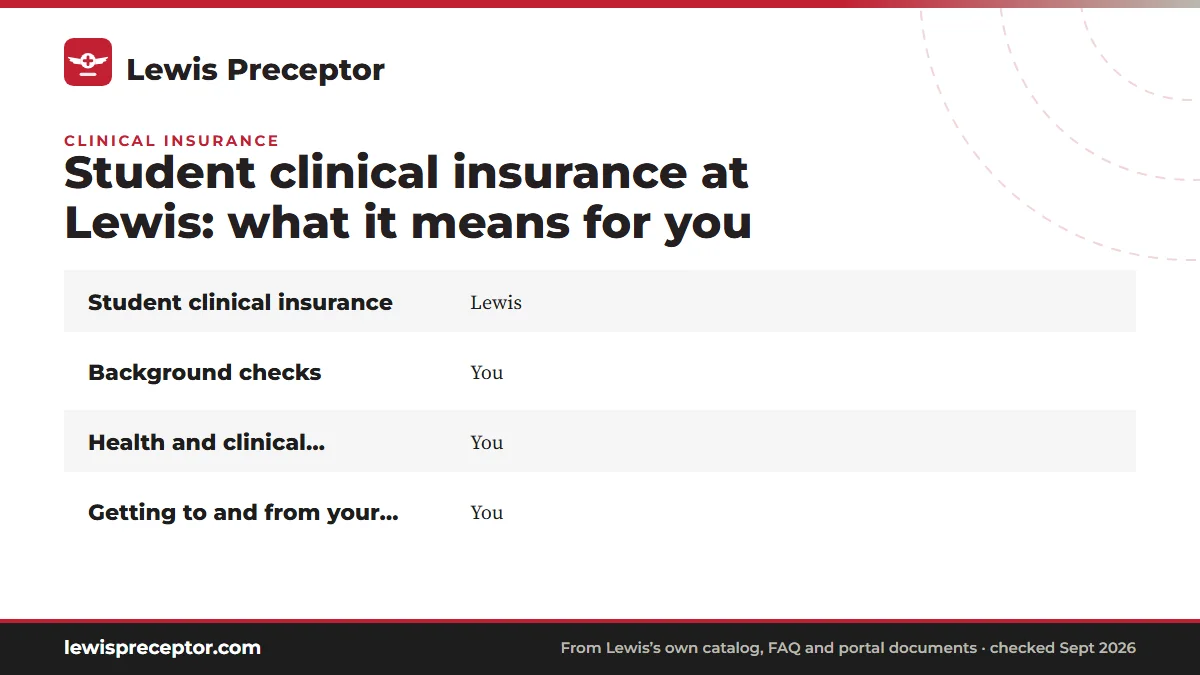
What Lewis covers and what you pay
The two lines that settle the money question sit side by side in Lewis's graduate materials. The FAQ states that "The University covers the cost of student clinical insurance." The same FAQ, backed by the MSN and DNP catalog pages, leaves students paying every fee for background checks and for health and clinical documentation ahead of clinical work.
| Item | Who pays | Lewis source |
|---|---|---|
| Student clinical insurance | Lewis | Graduate nursing FAQ |
| Background checks | You | FAQ; MSN and DNP catalog pages |
| Health and clinical documentation, including your CastleBranch requirements | You | FAQ and catalog; CastleBranch is named in the contract status legend |
| Getting to and from your clinical site | You | University Student Handbook 2026-2027 |
The handbook line is about travel: Lewis groups nursing clinicals with internships and service work as trips it does not usually arrange transport for. Lewis prints no amounts for any of these items; your CastleBranch package and each agency set the actual list. CastleBranch at Lewis explains how that account works.
What the FAQ line does and does not tell you
The FAQ sentence is short, and Lewis publishes nothing beyond it: no carrier, no coverage limits, no certificate form and no description of how a site requests proof. The graduate nursing handbook that might hold those details is not public.
Two practical readings follow. First, arranging this coverage is not your job, because Lewis carries the cost. Second, when a clinic's onboarding team wants something in writing about coverage, that request belongs with Lewis rather than with you. Lewis names the Clinical Placement Office as your main contact during placement, and Lewis's contract legend says any extra documentation an agency requires goes to the agency and to that office.
Clinical insurance is also a separate matter from health insurance. The FAQ line says nothing about your own health coverage. Lewis's 2005 graduate forms stated that health insurance was required of nursing students in clinical courses, but the current graduate rule is not public. If a site or your CastleBranch package lists it, treat it as a requirement for clearance.
Stay inside what Lewis approved
Lewis's contract legend describes the Approved status narrowly. At that point the student is, essentially, able to start the practicum at the specific site, with the indicated preceptor(s), at the start of the semester named in the request. The simplest way to avoid any question about your standing as a student at a site is to keep your clinical time inside that approval. The contract portal guide covers every status.
Situations to raise with the Clinical Placement Office first
- A preceptor invites you to start before the semester, or before the portal shows Approved
- Your preceptor asks you to join them at a second clinic that is not in your request
- A different provider takes over precepting partway through the term
- Your request moves to Inactive or Denied, which the legend says can happen even after approval
Do not start clinical hours on a handshake. Wait until the portal shows Approved, work only at the site and with the preceptor(s) in your request, and check with the Clinical Placement Office before anything changes.
What to tell your preceptor and site
Preceptors and practice managers reasonably want to know where they stand before agreeing to host a student. Lewis's public record gives you three solid answers: Lewis covers the cost of student clinical insurance; the formal paperwork runs between Lewis and the agency as an affiliation agreement, which Lewis drafts when none is in place; and Lewis faculty approve each preceptor and site before you start.
Illinois APRN preceptors also have a professional reason to say yes, since precepting an APRN student can count toward their continuing education. The Illinois CE credit guide has the rule and the limits.
If the preceptor works at your own employer, you would be a student and an employee in the same building, and the lines between those roles need to be clear. Lewis has published nothing specific about clinicals at a student's workplace, so read clinicals where you work before you file.
Where insurance fits in clearance
Insurance is the part of clinical clearance that Lewis handles. The rest is yours, and it is where a start date can slip: the physical exam form, plus the bloodwork and immunizations that agency placement calls for, background checks, your CastleBranch requirements and any onboarding the agency adds.
Lewis's contract legend allows a request to be denied when a student falls short on CastleBranch requirements, so an incomplete package is a bigger risk to your semester than any insurance question. The clinical compliance checklist lays out every item Lewis names publicly.
Campus rules can add one more item: students carrying enough credit hours at Romeoville also owe the Student Wellness Center an immunization record, and the checklist explains who that covers. Graduate specifics such as titers, TB testing and BLS are not published, so they reach you through your CastleBranch package and each agency's onboarding.
How we handle the coverage conversation
When we approach a preceptor for you, we lead with what Lewis has published: the University covers the cost of student clinical insurance, Lewis handles the agency agreement, and Lewis faculty approve the placement. Preceptors hear a clear, accurate answer on the first call, and any request for paperwork is routed to the Clinical Placement Office from the start.
We keep your side moving too: the preceptor and site details the contract request needs, complete and ready to enter, reminders on CastleBranch items and agency onboarding, and a check that nothing starts before approval. Lewis students choose us because the clearance work gets the same care as the search itself, so your coverage answer, your paperwork and your start date are never left to guesswork. If a preceptor withdraws, we reopen the search at once. Tell us your practicum and term on the placement request form.
Questions Lewis students ask
Do Lewis nursing students need their own malpractice insurance?
Lewis's graduate FAQ says the University covers the cost of student clinical insurance, and Lewis publishes nothing asking students to buy a separate policy for their practicums. If a site asks you for a personal policy, raise it with the Clinical Placement Office before you buy anything, since agency paperwork runs through that office.
Does Lewis's student clinical insurance cover me at my job?
Lewis's FAQ describes student clinical insurance, which relates to your student practicum, and says nothing about work you do as an employed RN. Lewis has also published nothing specific about practicums at your own employer. If your preceptor works where you do, ask the Clinical Placement Office how Lewis handles that before you file a request.
Is health insurance required for Lewis clinicals?
Lewis's current graduate pages do not say. Its 2005 graduate forms required health insurance for students in clinical nursing courses, and agencies set their own onboarding requirements, so check your CastleBranch package and each agency's list. Treat anything listed there as required for clearance.
Who pays for background checks at Lewis?
You do. Lewis's FAQ and its MSN and DNP catalog pages put the fees for background checks, and for the health and clinical paperwork that readies you for clinicals, on the student. Student clinical insurance is the piece Lewis pays for.
What should I tell a preceptor who asks if I am insured?
Tell them Lewis's graduate FAQ says the University covers the cost of student clinical insurance, and that any documentation their practice needs will come through Lewis's Clinical Placement Office as part of the agency paperwork. Mention too that Lewis faculty approve every preceptor and site, and that the agency signs an affiliation agreement with Lewis where none exists.
Related pages
Last checked 2026-09-25
We check these pages against Lewis's own catalog, program pages and FAQ, its contract portal and Illinois law. Your course, your track coordinator and the Clinical Placement Office have the final word.
Lewis asks you to identify your preceptor. We do the searching.
Tell us your Lewis program, where you live and when your next practicum starts. We find preceptors near you who fit the course and prepare every detail the contract portal asks for, so your request goes in complete.
- Preceptors matched to the practicum: primary care for
NURS 61100andNURS 61800, acute care forNURS 62500, psychiatric care forNURS 63300 - Preceptor, license and site details ready for your preceptor contract request
- In your own community, anywhere Lewis enrolls you and your RN license is valid
Start your placement plan
Program, city and start date is all we need to begin.